China Top 10 Graphite Cooling Film Suppliers
China’s Graphite Cooling Film industry has become an important part of advanced thermal management. These thin, flexible sheets spread heat across smartphones, tablets, laptops, LED modules, and electric vehicle displays. Their performance depends on more than advertised thermal conductivity. Thickness, in-plane heat spreading, surface treatment, adhesive quality, and dimensional stability all influence real results.
Small details matter.
A film may look excellent on a laboratory datasheet, yet perform differently inside a tightly packed device. Engineers must examine thermal resistance, bending endurance, cleanliness, and compatibility with batteries or printed circuits. Professor Gang Chen, a leading thermal engineering researcher, has stated, “Thermal management is becoming more and more important as electronic devices become smaller and more powerful.” This observation explains why reliable supplier evaluation matters.
This guide reviews ten notable Chinese suppliers of Graphite Cooling Film. It considers manufacturing capability, research investment, product customization, quality systems, and application experience. Some suppliers focus on ultra-thin films for consumer electronics. Others serve automotive electronics, power modules, communication equipment, or energy-storage systems. The comparison is practical, but not absolute. Supplier rankings can change with material grades, production batches, and project requirements. That uncertainty deserves attention.
Buyers should request recent test reports, sample rolls, thickness tolerances, and thermal data measured under comparable conditions. They should also confirm whether the quoted results describe in-plane spreading or through-plane conduction. A lower price may appear attractive. It may not remain attractive after installation problems, uneven adhesion, or repeated thermal cycling. This overview offers a starting point, not a substitute for technical validation.
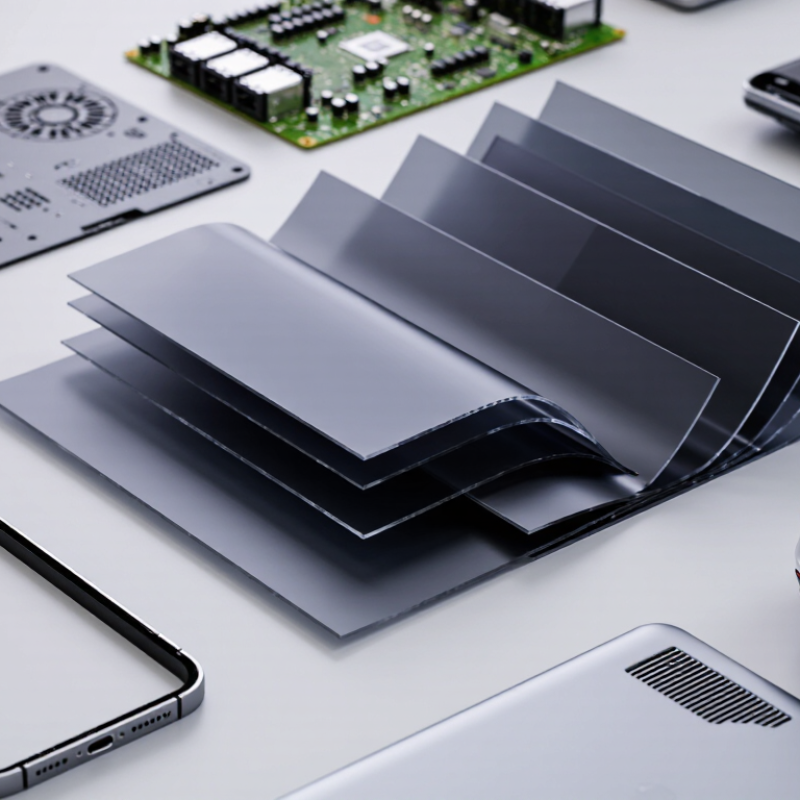
Graphite Cooling Film: Definition, Structure, and Thermal Advantages
China Top 10 Graphite Cooling Film Suppliers
Graphite Cooling Film: Definition, Structure, and Thermal Advantages
Graphite cooling film is a thin, flexible sheet designed to spread heat across a device surface. It does not generate cooling; it moves heat away from concentrated hot spots. Many films contain highly aligned graphite layers, which guide heat readily along the sheet but much less effectively through its thickness. That contrast matters.
Published measurements for highly oriented graphite commonly show in-plane thermal conductivity around 1,000–2,000 W/m·K, while through-plane conductivity is only several W/m·K. These values are consistent with the technical reference Thermal Conductivity: Theory, Properties, and Applications, edited by T. M. Tritt (Kluwer Academic/Plenum, 2004). They describe graphite, not every commercial film. Real performance depends on film thickness, layer alignment, contact pressure, and the surfaces it touches. A small air gap can weaken heat transfer, even when the sheet itself conducts well.
Tips: Check both in-plane and through-plane data before comparing films. Test the material in the actual device stack, including adhesive and nearby heat sinks. Numbers alone can mislead. A film may spread heat across a phone chassis, yet still need a path to release that heat into the surrounding structure.
China Top 10 Graphite Cooling Film Suppliers - Graphite Cooling Film: Definition, Structure, and Thermal Advantages
Graphite cooling film is a thin, flexible thermal-spreading sheet. The values below are general material characteristics, not specifications for any particular supplier or product. Actual performance depends on grade, construction, test method, and installation.
| No. | Dimension | Description and Typical Information | Thermal or Design Relevance |
|---|---|---|---|
| 1 | Definition | A graphite cooling film is a sheet-form thermal interface or heat-spreading material made primarily from graphite. | It spreads heat laterally from a concentrated hot spot; it does not remove heat without a path to a cooler surface or the surrounding environment. |
| 2 | Core material | The graphite layer may be made from natural graphite or synthetic graphite, depending on the product design. | Material choice affects conductivity, flexibility, consistency, and processing characteristics. |
| 3 | Layer structure | A typical construction has a graphite layer; some products add a protective polymer film, adhesive layer, or other backing. | Added layers can improve handling or electrical insulation but may affect total thickness and thermal resistance. |
| 4 | Thermal anisotropy | Graphite is anisotropic: its thermal conductivity is generally much higher along the sheet than through its thickness. | This makes graphite film useful for spreading heat across a surface, but it is not automatically a high-performance through-thickness heat conductor. |
| 5 | In-plane conductivity | Product datasheets commonly report high in-plane conductivity; reported values vary widely by grade and measurement method, and some products are specified in the hundreds of W/(m·K) or higher. | Higher in-plane conductivity can help distribute heat away from localized hot spots. |
| 6 | Through-plane conductivity | Through-plane conductivity is lower than in-plane conductivity for typical graphite sheets and should be checked in the product datasheet. | Contact quality, adhesive, surface flatness, and clamping can strongly influence heat transfer through the stack. |
| 7 | Thickness and flexibility | Graphite films are available in thin sheet formats; thickness and flexibility vary by grade and by any added backing or adhesive. | Thin, flexible formats can fit compact assemblies, but the finished construction—not just the graphite layer—sets the installed thickness. |
| 8 | Electrical behavior | Graphite is electrically conductive. Some film constructions include an insulating layer, while others do not. | Electrical isolation requirements should be checked before placing an uninsulated sheet near exposed conductors. |
| 9 | Thermal advantages | Potential advantages include low profile, flexibility, and effective lateral heat spreading in appropriately designed assemblies. | Performance depends on heat-source contact, sheet layout, boundary conditions, and the destination for the redistributed heat. |
| 10 | Selection checks | Compare the specified conductivity direction, thickness, electrical insulation, adhesive or backing, temperature limits, and test method. | Use application-level testing or a thermal model to confirm performance; datasheet values alone may not represent the installed assembly. |
Related Posts
-
What Is the Best Graphite Thermal Film for 2026?
-
Top 5 Benefits of Using Graphite Cooling Film in Electronics
-
Exploring the Versatility of the Best Graphite Sheet: Unique Use Cases and Applications
-
10 Essential Tips for Choosing the Right Graphite Cooling Film for Your Needs
-
How to Choose the Best Flexible Graphite Gasket for High Temperature Applications
-
How to Choose the Best Thermal Graphite Film for Your Application