Who Are the Top Thermal Graphite Sheet Suppliers in China?
Choosing a Thermal Graphite Sheet supplier in China takes more than comparing price lists. These thin, dark films can spread heat rapidly across a phone chassis, display module, or battery enclosure, but performance depends on grade, thickness, orientation, and processing. A sheet rated for high in-plane conductivity may still disappoint if its contact surface, cut shape, or installation path is poorly matched to the device. Details matter.
MIT materials scientist Gang Chen is a recognized authority on heat transfer. The following is an editorial paraphrase of the principle behind his field of research, not a verbatim quotation: “A material helps only when the full path lets heat move away.” That is a useful lens for assessing supplier claims. Ask for current technical data sheets, test methods, thickness tolerances, and sample results. Check whether the supplier can explain how its product behaves in your actual assembly, not just in a laboratory test. Small gaps can change the outcome.
This guide examines leading Chinese suppliers through practical criteria: product consistency, customization capability, quality controls, documentation, and export experience. Supplier rankings can shift as product lines and manufacturing capacity change. Treat them as a starting point, not a guarantee. I have also left room for a less tidy reality: public specifications do not always reveal batch variation or application-specific limits. A careful sample evaluation remains essential.
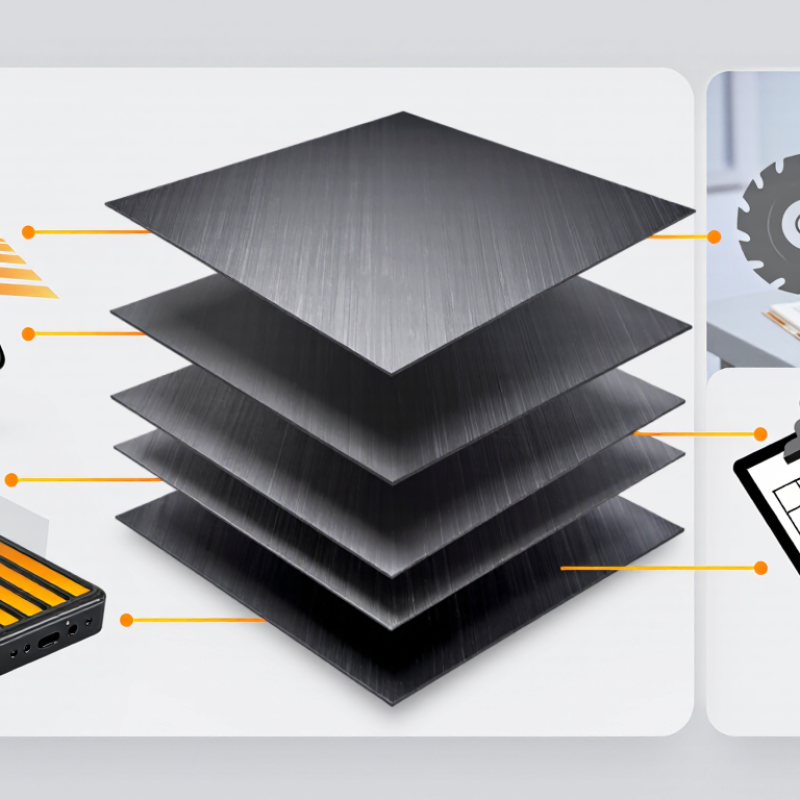
Thermal Graphite Sheets Defined: In-Plane Conductivity Can Reach 1,500 W/m·K
Thermal graphite sheets are thin, flexible materials designed to spread heat along their surface. In-plane conductivity can reach 1,500 W/m·K in some grades, but that figure is not universal. It depends on material structure, processing, and test method. Direction matters.
That number can mislead. A sheet may move heat quickly from a hot processor toward a wider area, yet conduct far less heat through its thickness. Picture a phone with a graphite layer beneath a warm chip: heat spreads sideways across the sheet, helping reduce concentrated hot spots. The sheet does not remove heat by itself; the surrounding design must transfer it to a frame or other heat-dissipating part.
When comparing Chinese suppliers, check whether conductivity data refers to the in-plane direction and ask for the testing conditions. Also review thickness tolerance, density, flexibility, and performance after repeated bending. A sample should be measured in the intended assembly, not only viewed on a specification sheet. Small gaps or poor contact can weaken heat transfer. Real results vary. A clear datasheet and consistent sample quality are useful signs, though neither replaces application testing.
Thermal Graphite Sheets: In-Plane Conductivity Can Reach 1,500 W/m·K
Selected room-temperature thermal conductivity values, in watts per meter-kelvin (W/m·K).
High-performance thermal graphite sheets can reach approximately 1,500 W/m·K along the sheet plane. Actual values vary by grade, direction, and measurement method; the other figures are representative approximate values for comparison.
Supplier Ranking Criteria: Compare Conductivity, Thickness, Density, and Tolerance
When comparing thermal graphite sheet suppliers in China, conductivity figures need context. Ask whether the value is measured in-plane or through-plane, and request the test method and sample direction. A high in-plane result may help spread heat across a phone chassis, but it does not guarantee better heat transfer through a stacked assembly. Check whether reported figures come from production material or selected samples.
Thickness affects fit, contact, and thermal performance. Compare nominal thickness with the supplier’s stated tolerance, then inspect several points across sample sheets using a calibrated gauge. Density also matters: it can indicate how compact the sheet is, but density alone cannot confirm conductivity or durability. Small differences matter. Request samples from more than one production lot when consistency is important.
A useful supplier ranking should weigh all four measures together, rather than reward one impressive specification. Ask for recent inspection records, clear measurement units, and details about test conditions. Confirm that the quoted tolerance matches the material you will actually buy. A ranking can still mislead if testing methods differ, or if a supplier’s sample is not representative. Even careful checks have limits; assembly pressure and surface contact can change real-world results.
Who Are the Top Thermal Graphite Sheet Suppliers in China? — Supplier Ranking Criteria: Compare Conductivity, Thickness, Density, and Tolerance
| Evaluation criterion |
Typical commercial reference range |
How to compare suppliers |
Suggested weight |
| Thermal conductivity |
Flexible graphite sheets are commonly specified with in-plane conductivity in the hundreds of W/(m·K); published grades can span roughly 300–1,500 W/(m·K). Values depend on material, processing, and test method. |
Compare the same direction and test method. Require separate in-plane and through-plane values where relevant; do not treat them as interchangeable. Higher verified in-plane conductivity is useful for spreading heat laterally. |
35% |
| Thickness |
Commercial sheet offerings commonly include thin grades around 0.025 mm and thicker grades up to approximately 1.0 mm or more, depending on product construction. |
Check the nominal thickness against the assembly design and request actual measurement results. Compare products at the same nominal thickness because thermal and mechanical performance can change with thickness. |
20% |
| Density |
Flexible graphite sheet grades are often specified at approximately 0.7–2.0 g/cm³. The available range varies by grade and manufacturing process. |
Compare density alongside conductivity, compressibility, and mechanical requirements. A higher density alone does not establish better thermal performance. |
15% |
| Thickness tolerance |
Tolerances are product- and order-specific; there is no single tolerance that applies to every graphite sheet. Buyers commonly specify a drawing tolerance or a supplier-agreed limit. |
Request the stated tolerance, inspection method, and batch measurement records. Score suppliers higher for meeting the buyer’s required tolerance consistently—not merely for quoting a small nominal tolerance. |
20% |
| Test documentation and consistency |
Test results should identify the test method, sample thickness, measurement direction, conditioning, and units. Results from different methods may not be directly comparable. |
Request datasheets and recent lot-level inspection records. Give preference to clearly documented, repeatable results that match the supplied grade and production batch. |
10% |
Note: The ranges above are general screening references drawn from commonly published flexible graphite sheet specifications; they are not verified specifications or rankings for named suppliers. Actual values vary by grade, construction, and test method. A supplier ranking should be based on comparable samples, agreed test procedures, and the buyer’s application requirements.
Leading Chinese Suppliers: Assess Product Range, ISO 9001, and Production Scale
China’s thermal graphite sheet suppliers should be assessed by more than catalogue size. Look for natural and synthetic graphite options, thickness and sheet-size ranges, adhesive backing, insulation layers, and die-cut parts. Ask for thermal-conductivity test methods and sample results; a single headline value can hide differences in direction, thickness, and test conditions. Details matter.
The USGS Mineral Commodity Summaries 2025 estimates China produced about 1.27 million tonnes of natural graphite in 2024. That signals a strong raw-material base, not verified sheet-making capacity. Buyers should request factory-level evidence, such as monthly output, equipment lists, yield records, and lead times. Scale claims need checking.
ISO 9001 certification can indicate a documented quality-management system, but it does not certify a sheet’s thermal performance. Confirm that the certificate covers the manufacturing site and relevant processes, then review inspection records for thickness, density, and batch consistency. A practical audit might trace one production lot from incoming graphite to packed sheets. Even then, one weakness remains: public supplier data often omit comparable capacity figures, so independent verification is valuable.